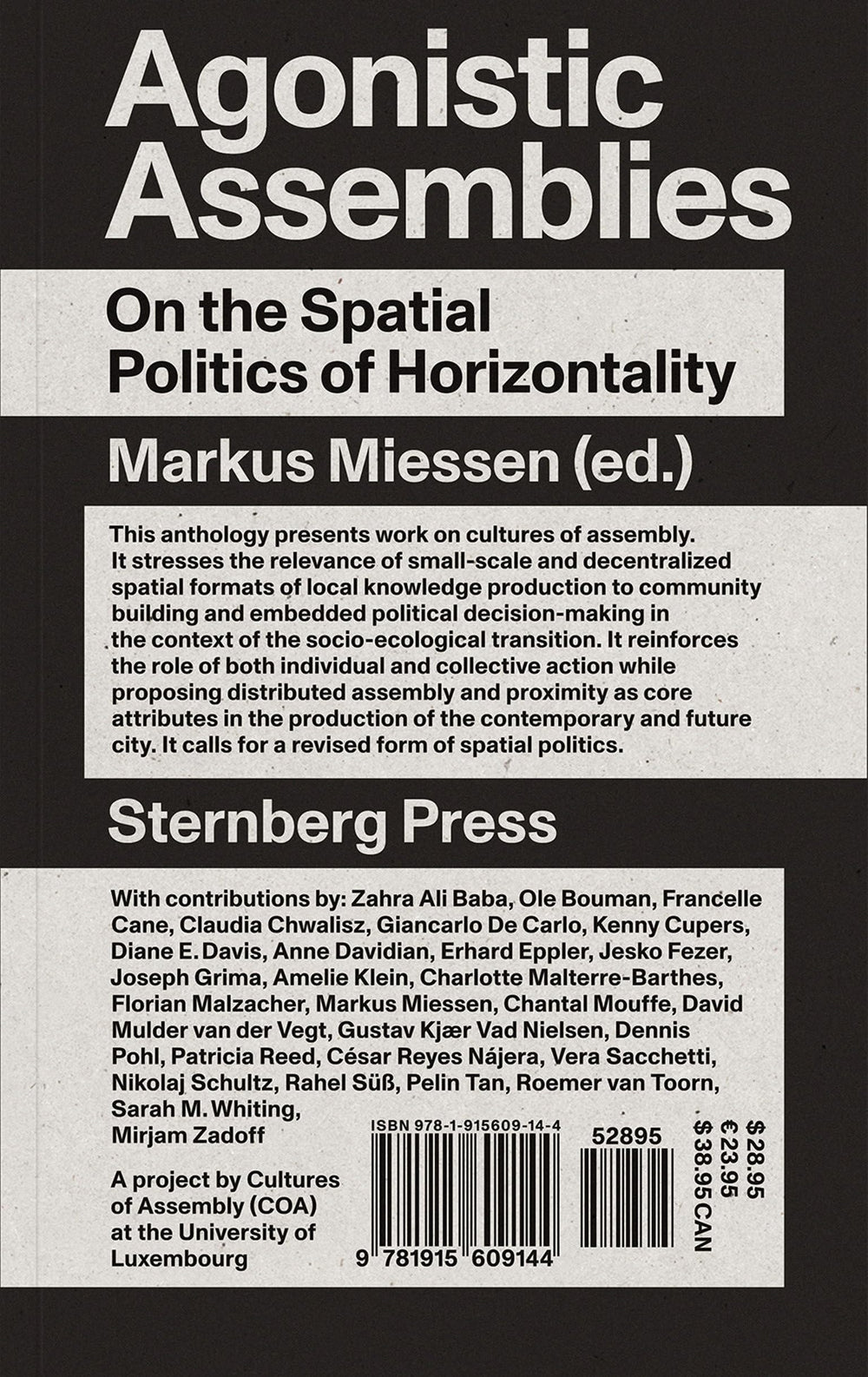
Agonistic Assemblies On the Spatial Politics of Horizontality
Original price was: $5.83.$2.99Current price is: $2.99.
A call for a revised form of spatial politics.
This anthology presents work on cultures of assembly. It stresses the relevance of small-scale and decentralized spatial formats of local knowledge production to community building and embedded political decision-making in the context of the socio-ecological transition. It reinforces the role of both individual and collective action while proposing distributed assembly and proximity as core attributes in the production of the contemporary and future city. It calls for a revised form of spatial politics.
Miessen’s ongoing research trajectory Cultures of Assembly was initially kicked off during a Harvard GSD fellowship in collaboration with Joseph Grima, in which the two architects investigated the sociopolitical dimension of (urban) spatial design. Observing the Kuwaiti cultural and social landscape with a specific interest in the politico-spatial phenomenon of Diwaniya, this distributed urban form of para-institutional assembly established a starting point for a long-term body of research.
Diwaniya can be understood and interpreted in multiple ways. Beyond a techno-futuristic idea of progress, it presents a showcase of an alternative that attempts to imagine a model of a (more) solidary city. On the scale of a city, and in fact small country, it interrogates how we-as a society-can learn from and produce alternative formats of physical exchange, working towards realistic scenarios of decentralized decision-making and spatial justice.
Agonistic Assemblies asks: how can spaces-both physical and virtual-be envisaged to create publics? How is collectivity and society being generated spatially and in terms of policy? How do we “practice” society as a bodily, spatial form, and how does this practice contribute to spatial justice? Are there specific spatial settings that can intensify these practices? What kind of spatial design can we imagine as platforms for change?
Central to this project is the reflecting on and rendering of the underlying driving forces of informal institution building at the interface of agonistic (urban) spatial politics-in a global political climate facing what Mark Fisher famously framed as “capitalist realism” in conjunction with the social-ecological transition while, arguably, also facing a crisis of imagination.
This project articulates a curatorial impetus towards urban policy making in conjunction with spatial proximity as a tool to mediate between the individual, the collective, the neighborhood, the city, state politics, and society at large. If we understand assembly as a form of spatial gathering, and the bonfire as the prehistoric space of assembly, what constitutes its contemporary equivalent?
Contributors
Zahra Ali Baba, Ole Bouman, Francelle Cane, Giancarlo De Carlo, Claudia Chwalisz, Kenny Cupers, Anne Davidian, Diane E. Davis, Erhard Eppler, Jesko Fezer, Joseph Grima, Amelie Klein, Charlotte Malterre-Barthes, Florian Malzacher, Markus Miessen, Chantal Mouffe, Gustav Kjær Vad Nielsen, César Reyes Nájera, Dennis Pohl, Patricia Reed, Vera Sacchetti, Nikolaj Schultz, Rahel Süss, Pelin Tan, Roemer Van Toorn, David Mulder Van Der Vegt, Sarah M. Whiting, Mirjam Zadoff